The Race Pace Planner
Turn a race you have run into a goal you can hold: an honest goal, a pace that does not drift, the time at every marker, the pace for a watch that reads long, and a tune-up checkpoint
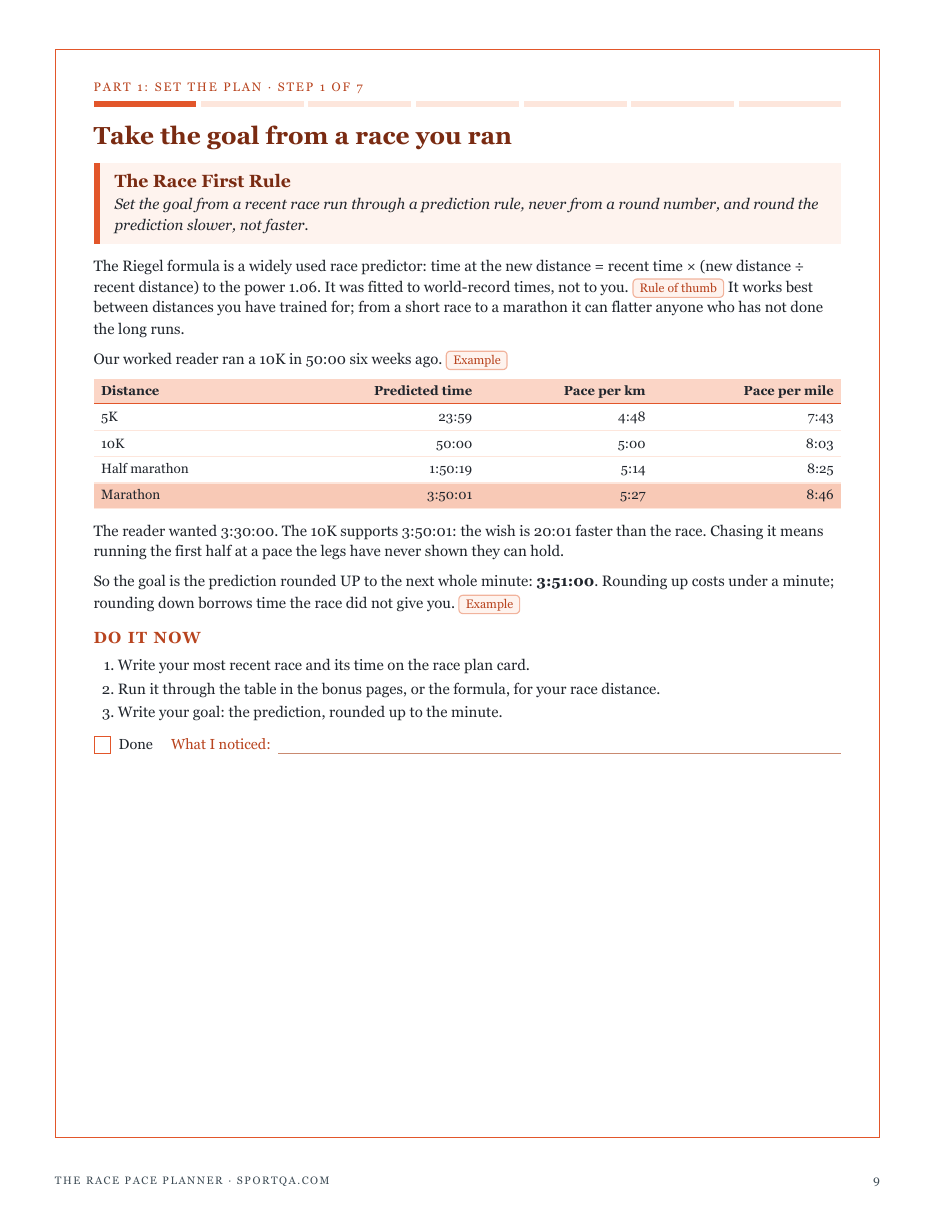
SportQA's free Running Pace Calculator answers one question well: you ran this far in this time, so what was your pace? A race plan needs the questions after it. What goal does a recent race support? What should the clock read at each marker? And what happens when you run the pace your watch rounds to the second, on a watch that reads long, for 42 kilometers? While writing this pack we found our own calculator rounding the pace before converting it (a 3:20:00 marathon showed 7:37 a mile instead of 7:38) and fixed it. The Race Pace Planner joins it up. In the worked example, a 50:00 10K predicts 3:50:01 for a marathon, so the goal is 3:51:00, not the 3:30:00 the runner wanted; a watch that reads 1% long turns goal pace into a 2:19 late finish, so the pace to run on the watch is 5:25, not 5:28; and a 1:52:00 tune-up half moves the goal to 3:54:00 while there is still time. Seven steps cover a goal from a race you ran, pacing from the total instead of a rounded pace, marker times, the watch correction, easy runs by one heart rate method, a tune-up checkpoint and a start without "banking" time. Every figure is computed from our own calculators, and the worked numbers are examples, tagged as such; race predictions use the Riegel formula, a rule of thumb. It is a pacing planner, not coaching or medical advice: it gives no food, fluid or body-weight advice, and it carries the see-a-doctor and drink-to-thirst lines. Included: 24 printable pages with a race plan card, a kilometer band, a training week log, a tune-up and race-week sheet, reference tables and a quickstart, plus a personalised sheet worked from the numbers you enter in the Running Pace and Heart Rate Zone calculators.
Look inside
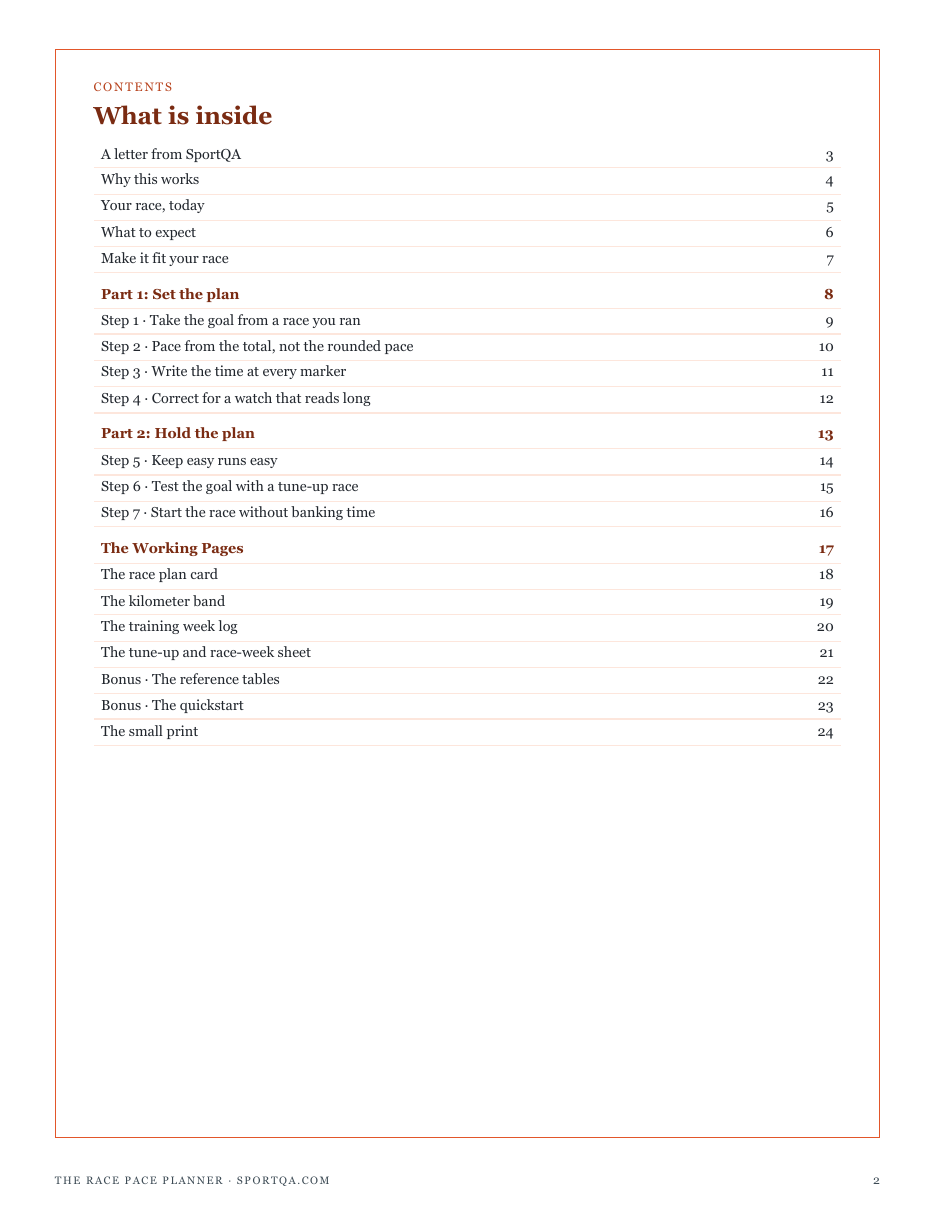
Two full pages from the planner, exactly as printed. Click either to read it at full size before you decide.
What is in it
- The Race First Rule: the goal from a recent race through the Riegel rule of thumb, rounded up to the minute, with equivalents at 5K, 10K, half and marathon
- The One Rounding Rule: why a pace rounded to the second lands a 3:30 marathon at 3:30:16, and how to pace from the total instead
- The Marker Rule: elapsed time at every 5 km, halfway and the finish, each worked from the goal
- The Long Watch Rule: your watch's over-read from a past race, and the watch pace that lands the goal
- The Easy Means Easy Rule: the heart rate zone calculator's two methods side by side, one Zone 2 and the talk test
- The Checkpoint Rule: a tune-up race 3 to 6 weeks out, and when to move the goal
- The No Bank Rule: how little time a fast start banks and how little slowing gives it back
- Four working pages: a race plan card, a kilometer band, a training week log and a tune-up and race-week sheet
- Reference tables of finish times by pace for 5K to marathon and equivalent times from a 10K, and a quickstart
- A personalised sheet worked from the figures you enter in the Running Pace and Heart Rate Zone calculators
- ✓ 24 printable pages
- ✓ 10 sections, worksheets and templates
- ✓ A second PDF worked out from the numbers you enter
- ✓ No account needed, just an email address
- ✓ Instant download; link valid 7 days
Price includes any taxes. Sold by GrabURL, who handle checkout and support. The charge appears on your statement as GrabURL.
The planner picks up where the free Running Pace Calculator leaves off. The calculator turns a race into a pace; the planner turns a recent race into an honest goal, the elapsed time at every marker, the pace to run on a watch that reads long, and a tune-up checkpoint, and it keeps easy runs easy with the Heart Rate Zone Calculator. It is a pacing planner, not coaching or medical advice, and it does not tell you what to eat or drink. Check with a doctor before starting vigorous exercise if you have a heart condition.